Table of contents (31)Show
- What to do now
- RedotPay and India, checked in November 2026
- What RedotPay actually does
- Why FIU-IND registration applies to a card app
- Late October 2026: the cards stop working
- Crypto cards under FEMA and LRS
- What RedotPay's referral scheme pays
- When RedotPay won't cooperate from India
- Getting your money out of RedotPay
- Registered alternatives
- Q: Which company is behind the RedotPay app?
- Q: What licences does RedotPay display?
- Q: How widely used is RedotPay?
- Q: Who has invested in RedotPay?
- Q: How does RedotPay make money?
- Q: Is RedotPay a crypto exchange?
- Q: Which other crypto cards are under scrutiny in India?
- Q: Can the RedotPay app still be opened from India?
- Q: Has RedotPay commented on the Indian reports?
- Q: How is a RedotPay card different from an Indian forex card?
- Q: Who gains more from a RedotPay code, the sharer or the new user?
- Q: Can a RedotPay code be added after registration?
- Q: Why do promoters push RedotPay sign-ups so hard?
- Q: Are RedotPay promo codes and referral codes the same thing?
- Q: Is a RedotPay referral commission taxed in India?
- Q: Can I earn RedotPay commission by inviting friends abroad?
- Q: Is there a best RedotPay referral code?
- Q: Do RedotPay's Earn products protect your money?
- Q: A Telegram group sells RedotPay cards 'activated for India'. Is that real?
- Q: Does using a RedotPay link change the card fee a friend pays?
- Quick FAQs
RedotPay, the Hong Kong app that turns stablecoins and other crypto into Visa card payments, isn't on India's list of crypto platforms registered with FIU-IND, so there's no RedotPay referral or invite code on this page. RedotPay's own help centre also lists India among the places whose residents can't get its virtual or physical cards, and since late October 2026 Indian users have reported their cards being declined at home.
Here's what RedotPay offers, where it stands under Indian law, what its referral scheme pays and to whom, and how to take your money out if you already have an account.
RedotPay and India, checked in November 2026
| Question | Answer |
|---|---|
| What RedotPay is | Crypto-funded Visa cards plus a wallet, swaps, P2P and credit |
| Based in | Central, Hong Kong; founded 2023 |
| Registered with FIU-IND? | No. Not among the 54 names as of 9 March 2026 |
| On the takedown list? | No. Not among the 53 names in the same answer |
| Cards for Indian residents | Restricted by RedotPay itself |
| Regulators' interest | RBI and FIU-IND reportedly examining offshore crypto cards |
| Android app | RedotPay: Crypto Card & Pay, by Red Dot Technology Limited |
| What a code does | Pays the sharer commission on your card fee and spending |
What RedotPay actually does
RedotPay started in 2023 and says it has more than 9 million users in over 100 countries. Its core product is a prepaid card, virtual or physical, that converts BTC, ETH, USDT or USDC into local currency at the moment you pay, at shops, online and at ATMs. Around it sit a multi-currency wallet, coin swaps, a P2P marketplace, interest-paying Earn products and loans against crypto.
The licences it shows are Hong Kong money lender's licences and a registration with Argentina's securities regulator as a virtual asset provider. None is Indian. The company is also heading for the stock market: Bloomberg reported in October 2026 that RedotPay planned a confidential US listing filing by the end of the year, after raising $194 million in 2025.
Why FIU-IND registration applies to a card app
The activities that count
The government's notification of 7 March 2023 brought crypto service providers under the Prevention of Money Laundering Act. It covers exchanging crypto for money or for other crypto, transferring it, and holding it on behalf of customers. RedotPay's wallet keeps coins for users, swaps them and converts them to currency at the till, so serving Indian residents falls under that rule, wherever the company's office is.
What the March 2026 list shows
The Finance Ministry's answer to Lok Sabha unstarred question 5805, dated 30 March 2026, printed the 54 platforms registered as of 9 March 2026. RedotPay isn't there. Nor is it among the 53 platforms whose apps and URLs FIU-IND ordered taken down, or the 15 that received notices on 9 September 2026. That's a gap, not a clean chit: an unregistered platform files no reports in India and gives you no Indian body to complain to.
Late October 2026: the cards stop working
Around 29 October 2026, Indian users began posting that RedotPay and similar crypto cards were being declined for payments inside India, and some said provider websites stopped loading. On 2 November, The Economic Times reported that the RBI and FIU-IND were examining offshore crypto cards, RedotPay among them, for possible breaches of payment, foreign-exchange and anti-money-laundering rules.
How it came to light
A Bengaluru research group, Digital South Trust, got a virtual RedotPay Visa card in August 2026, made several domestic online payments with it and passed its findings to Indian authorities.
What hasn't been confirmed
No regulator has named RedotPay in an order, and talks between the card networks and Indian authorities remain unconfirmed. The clearest signal comes from RedotPay itself. Its card issuance restrictions page lists more than 40 places, from Indonesia and Nepal to the United States, whose residents are "ineligible for both virtual and physical cards", and India is one of them.
Crypto cards under FEMA and LRS
Paying Indian shops
Prepaid instruments used in India need RBI authorisation under the Payment and Settlement Systems Act, 2007. A card issued abroad and topped up with crypto sits outside that system. Lawyers quoted in the coverage say holding coins with a foreign custodian to fund rupee spending raises FEMA questions, and the conversion happens offshore, out of sight of Indian banks.
Spending abroad on a trip
A resident's foreign spending normally runs through Indian banks under the Liberalised Remittance Scheme, capped at $250,000 a financial year, with TCS collected on larger remittances. RBI has never said LRS money may be used to buy crypto, and in 2021 ICICI Bank added a declaration to its outward remittance form confirming the money isn't for crypto. Sending USDT abroad to load a RedotPay card skips that whole system. FEMA does get enforced on crypto: in 2021 the Enforcement Directorate issued a show-cause notice to WazirX over crypto worth about ₹2,790 crore sent to unidentified wallets.
Tax on every swipe
Paying with BTC or ETH on a crypto card means selling it first, and each sale is a transfer of a virtual digital asset: 30% tax on any gain plus cess, with no set-off for losses. A balance held with a foreign company may also have to be shown as a foreign asset in your return, so ask a chartered accountant.
What RedotPay's referral scheme pays
RedotPay's referral rules reward the person sharing a code in three ways:
- a cut of the card fee when the friend orders a virtual or physical card, paid straight away;
- a percentage of every card payment the friend makes, settled every 30 days;
- 10% of the friend's own commission when they invite others.
Rates climb with the number of people you bring in, and the Play Store listing advertises up to 40%. Large accounts can apply for a Partner Program with higher rates. No card commission is paid when the friend uses a discount of 50% or more, and commission on refunded orders is clawed back.
The free $5 and $10 claims
The 5 USD on code sites is RedotPay's welcome credit for new users. It lasts 30 days, can't pay the card fee and can be spent only once a card is active. For an Indian resident who can't get a card, it has nowhere to go. The $10 versions come from promoters; RedotPay's own pages don't promise them.
Why we don't print a code
Every RedotPay code earns its owner commission on a friend's card fee and spending. Publishing one would steer Indian readers to an unregistered service that excludes them from its main product, in the middle of a regulatory review. We don't explain how to find your own RedotPay code either.
When RedotPay won't cooperate from India
The card order stops at the address
That's RedotPay's rule, not a glitch. Borrowing a relative's foreign address breaks its terms, and accounts can be reviewed at any time.
Swipes fail at Indian merchants
That matches what users have described since late October. Retrying won't get around a block applied by the issuer or the card network.
Someone offers a ready-made card
Pre-verified cards sold in chat groups run on another person's identity. The seller can take the account back, RedotPay can freeze it, and the balance was never legally yours.
Getting your money out of RedotPay
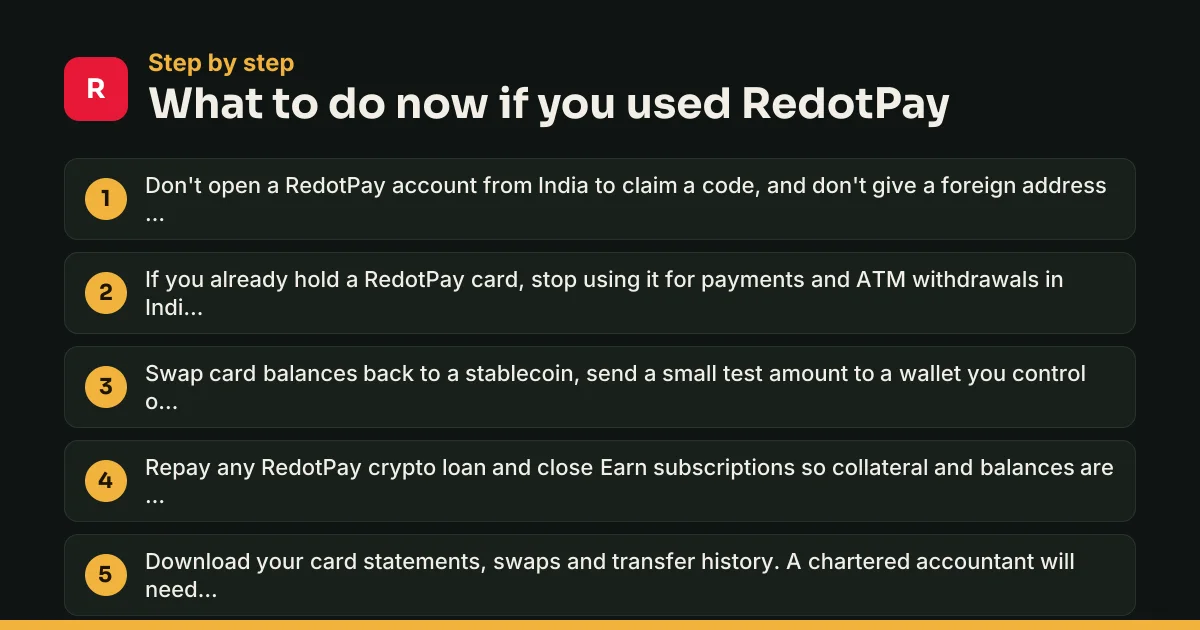
Move your balance before anything else changes. Swap card funds back to a stablecoin, send a small test amount to a wallet you control or an FIU-registered Indian exchange, check it arrived on the right network, then move the rest. Repay any crypto loan first so the collateral is released, and download your statements before closing the account.
Registered alternatives
For crypto with an Indian sign-up offer, use exchanges on FIU-IND's list: CoinDCX, ZebPay, Mudrex and WazirX in India, or Binance and Bybit offshore. For travel, a forex card or international debit card from an Indian bank stays inside LRS. Browse more crypto exchange referral codes, read what a referral code is, and report fraud on 1930 or at cybercrime.gov.in.
Q: Which company is behind the RedotPay app?
The Android app, RedotPay: Crypto Card & Pay, is published by Red Dot Technology Limited. Reporting on the company places its headquarters in Central, Hong Kong, gives 2023 as its founding year and puts its staff at about 280. It calls itself a fintech service provider, not a bank, and says its multi-currency accounts are run by licensed partners.
Q: What licences does RedotPay display?
Its website shows Money Lender's Licence No. 1715/2025 and its Play Store listing shows No. 1550/2024, both with Hong Kong hotline numbers. The website footer also carries registration No. 144 with Argentina's securities regulator, the CNV, as a virtual asset service provider. None of these is an Indian authorisation, and a lending licence doesn't cover card issuing.
Q: How widely used is RedotPay?
RedotPay's website claims more than 9 million users in over 100 countries and about $12 billion of annual payment volume, while its Play Store description still says 5 million. In November 2026 the Android app showed more than 50 lakh downloads and a 4.7-star average from about 82,700 reviews. All the user counts are the company's own.
Q: Who has invested in RedotPay?
RedotPay raised $194 million in 2025, including a Series B of roughly $100 million in December. Reports name Coinbase's venture arm, Sequoia Capital and Vertex Ventures, a Temasek subsidiary, among its backers. In October 2026, Bloomberg reported pre-IPO funding talks at a $4 billion to $5 billion valuation, and discussions with J.P. Morgan, Goldman Sachs, Jefferies and Barclays about a US listing.
Q: How does RedotPay make money?
The company hasn't published a breakdown. Its products suggest the main sources: card fees, payment and currency conversion charges, interest on crypto-backed credit, and its swap and P2P services. According to the October 2026 reporting, annualised revenue passed $100 million within 18 months of launch and has since reached about $180 million.
Q: Is RedotPay a crypto exchange?
Not in the usual order-book sense, but it does swap BTC, ETH, USDT, USDC and other coins inside the app, runs a P2P marketplace and holds coins for users. Indian anti-money-laundering rules look at those activities rather than the label, which is why a card-and-wallet app needs FIU-IND registration just as an exchange does.
Q: Which other crypto cards are under scrutiny in India?
The November 2026 reports describe offshore prepaid cards that let residents spend crypto at Indian shops and draw rupees from ATMs. RedotPay's cards run on Visa; other programmes use Mastercard. Some cost about $40 to $50, last three years and carry high limits. Visa said in October 2026 that more than 225 stablecoin-linked card programmes run on its network.
Q: Can the RedotPay app still be opened from India?
When we checked in November 2026, India wasn't on RedotPay's list of locations blocked from the app, dated 28 August 2026, or on its list of countries barred from registration. The card is where India is excluded. Some Indian users have also reported provider websites not loading. RedotPay says these lists change as regulations evolve.
Q: Has RedotPay commented on the Indian reports?
We found no public RedotPay statement on the Indian card problems. In the same news cycle, it disputed reports that its listing plans had been postponed, and coverage noted it had completed a financial audit and an anti-money-laundering controls assessment in September 2026. Visa, Mastercard and the RBI didn't answer the newspaper's questions either.
Q: How is a RedotPay card different from an Indian forex card?
A forex card comes from an Indian bank, is loaded with rupees converted into foreign currency, and each load is reported under LRS with TCS where it applies. A RedotPay card is issued abroad and funded with crypto held by a foreign company, so none of that Indian reporting happens. That difference is what regulators are reportedly examining.
Q: Who gains more from a RedotPay code, the sharer or the new user?
The sharer, by a long way. They earn a cut of the friend's card fee at once, then a percentage of every card payment, settled every 30 days, plus 10% of any commission the friend later earns from their own invites. The new user's 5 USD welcome credit is a standard offer that RedotPay's help page describes for new users generally.
Q: Can a RedotPay code be added after registration?
No. RedotPay's referral rules say codes must be entered while registering and can't be added to existing accounts. That's one reason promoters push people to sign up through their link before doing anything else. For an Indian resident, the timing question is moot, because the card that makes the account useful isn't available.
Q: Why do promoters push RedotPay sign-ups so hard?
Because the commission keeps coming. Every time a referred friend pays with the card, the sharer earns a percentage, and the friend's own referrals add a further 10% layer. Big accounts can apply for RedotPay's Partner Program for higher rates. A promoter can keep earning from your spending long after the sign-up video is forgotten.
Q: Are RedotPay promo codes and referral codes the same thing?
No. A referral code links your account to the person who invited you. Promo or discount codes cut the price of a card order, and RedotPay pays the referrer no card commission when the friend uses a discount of 50% or more. Many code pages blur the two, which is why their promised savings rarely match what appears in the app.
Q: Is a RedotPay referral commission taxed in India?
Yes, as income, valued in rupees when it's credited. If it's paid in crypto and you later sell or spend it, that's a crypto transfer taxed at 30% on any gain. An offshore company won't deduct Indian TDS or issue a certificate, so keep your own records and let a chartered accountant decide how to report it.
Q: Can I earn RedotPay commission by inviting friends abroad?
RedotPay may well pay you, but you'd be an Indian resident building income from a crypto service that isn't registered here, during a reported RBI and FIU-IND review. The income would still be taxable in India, and the account itself could face restrictions. We don't help with RedotPay referrals from India, at home or abroad.
Q: Is there a best RedotPay referral code?
No. The 5 USD welcome credit described on RedotPay's help page is the same for every new user, so one code can't give you more than another. What differs is who collects commission on your card fee and future spending. Labels such as 'best', 'verified' or 'highest bonus' on code pages are marketing for the promoter.
Q: Do RedotPay's Earn products protect your money?
No. The Earn feature pays daily interest on USDC or USDT with no lock-up, but RedotPay's own listing warns that Earn products carry a risk of losing capital and are offered only in select regions. For someone in India there's also no Indian regulator overseeing the product or the company holding the coins.
Q: A Telegram group sells RedotPay cards 'activated for India'. Is that real?
No. RedotPay doesn't issue cards to Indian residents, so a working card sold for India was opened in someone else's name or with false address details, or it's a scam that disappears after you pay. Either way the balance isn't safely yours. Keep the chat and payment proof and report it on 1930 or at cybercrime.gov.in.
Q: Does using a RedotPay link change the card fee a friend pays?
RedotPay's referral page doesn't promise invited users any discount on card fees. It describes rewards only for the person who shared the link. Price cuts on card orders come from separate promo codes and limited-time campaigns, and those come with their own terms. The current fee for a virtual or physical card appears in the app before you pay.
RedotPay offer terms to know
- Since the government notification of 7 March 2023, businesses that exchange, transfer or hold crypto for people in India fall under the PMLA and must register with FIU-IND as reporting entities, wherever they are based.
- FIU-IND doesn't publish its register. The Lok Sabha answer of 30 March 2026 printed the 54 platforms registered as of 9 March 2026, and RedotPay isn't one of them.
- Prepaid payment instruments used in India need RBI authorisation under the Payment and Settlement Systems Act, 2007. A card issued abroad and funded with crypto sits outside that framework.
- Residents normally spend and invest abroad through Indian banks under the Liberalised Remittance Scheme, capped at $250,000 a financial year. RBI has never said LRS money may buy crypto, and banks have added declarations against it.
- RedotPay's card issuance page says residents of the listed regions, India included, are 'ineligible for both virtual and physical cards', and an address there can't be used for billing.
- Crypto gains are taxed at 30% plus surcharge and cess, losses can't be set off against other income, and selling crypto to settle a card payment is itself a taxable transfer.
- RedotPay's referral rules pay the sharer part of the friend's card fee and a share of their card spending; the friend's 5 USD welcome credit expires after 30 days and can't pay card fees.
RedotPay Referral Code: quick FAQs
Is there a RedotPay referral code for India?
Not on this page. RedotPay isn't registered with FIU-IND and doesn't issue cards to Indian residents, so we don't list a code.
Is RedotPay registered with FIU-IND?
No. It isn't among the 54 platforms registered as of 9 March 2026, per the government's Lok Sabha answer.
Is RedotPay banned in India?
No order naming it has been published, and it isn't on FIU-IND's takedown list. It's unregistered, and the RBI and FIU-IND are reportedly reviewing such cards.
Can Indian residents get a RedotPay card?
No. RedotPay lists India among the regions whose residents can't get a virtual or physical card.
Why was my RedotPay card declined in India?
Users have reported domestic declines since about 29 October 2026. Neither RedotPay nor the regulators have explained the cause publicly.
Can I withdraw my crypto from RedotPay?
We found no reports of frozen balances. Send a small test transfer to your own wallet or a registered exchange before moving the rest.
Does a RedotPay code give a $5 bonus?
The 5 USD welcome credit is for new users, lasts 30 days and needs an active card, which Indian residents can't get.
Written by Recharge n Deals Team
We sign up for every app we list, test the code ourselves and recheck it when the offer changes. Read how we test codes. Code not working? Tell us and we'll recheck it.
Disclaimer: RedotPay is a trademark of its owner. We are not affiliated with RedotPay. Offers are set by RedotPay and can change at any time; check the app before you sign up.