Table of contents (33)Show
- What to do now
- Cedar Pay in plain terms
- How a Cedar Pay trade works
- The commission table, and the question it raises
- Whose rupees reach your account
- "OTP-UPI" orders and linked payment apps
- One promoter network, several app names
- Not Cedar Money, and not Cedar's medical billing
- Can the RBI or NPCI vouch for Cedar Pay?
- Cedar Pay invite code searches, decoded
- Frozen bank account after Cedar Pay trades?
- Referral rewards that don't rent out your bank account
- Q: What is the Cedar Pay app?
- Q: Who owns or operates Cedar Pay?
- Q: Is Cedar Pay a UPI app?
- Q: Why does Cedar Pay ask me to allow installs from unknown sources?
- Q: Can I withdraw money from Cedar Pay to my bank?
- Q: What happens if a buyer says they paid but nothing arrived?
- Q: Does Cedar Pay have a customer care number?
- Q: Are Cedar Pay tokens a cryptocurrency?
- Q: Is Cedar Pay linked to RushPay?
- Q: Why do Cedar Pay sellers get a higher commission on small orders?
- Q: How much does someone earn when I join Cedar Pay with their code?
- Q: What is the 7,000 token bonus for 100 referrals?
- Q: Why does one Cedar Pay page show two different invite codes?
- Q: Can I get into trouble for posting my Cedar Pay invite code?
- Q: Is Cedar Pay's referral system a pyramid scheme?
- Q: My friend joined through my code and his bank account got frozen. What now?
- Q: Do 'Cedar Pay earning proof' videos show it really pays?
- Q: Is it safer to only buy tokens and never sell?
- Q: Which payment apps give real referral rewards?
- Q: How is a genuine invite code different from a Cedar Pay code?
- Quick FAQs
There's no Cedar Pay invite code on this page, and we'd steer you away from anyone else's. Cedar Pay trades in-app "tokens" between strangers: the buyer pays the seller over UPI, and the seller earns 2% to 6% extra for each sale. You can only get it as a sideloaded file, because Google Play doesn't carry it. Even its promoter page concedes the RBI doesn't regulate it and that some users' accounts have been frozen, a predictable result when money of unknown origin keeps arriving in your bank account.
Entering someone's code changes nothing for you; it simply routes 1% of your purchases to them. Here's how the token loop runs, the evidence that puts it in our scam column, and the way out if you've already traded.
Cedar Pay in plain terms
Cedar Pay calls itself a C2C, or customer-to-customer, platform for "digital tokens". That sounds like crypto, but we found no sign the tokens trade anywhere outside the app. They are entries in the operator's own ledger, bought from other users with rupees and sold back to other users for rupees. The rupees themselves move through ordinary UPI apps. The promoter page lists Google Pay, PhonePe, MobiKwik, super.money, Freo and Twid.
There's no company name, registered address or licence anywhere on that page, and we couldn't find a website run by the operator itself. The app is downloaded from a landing domain as an APK, after you switch on installs from unknown sources.
How a Cedar Pay trade works
Our source for the mechanics is caderpay.org, a page that misspells the brand, names no owner and attaches an invite code to every button. That makes it a promoter rather than the operator, and we had no way to test its claims in the app.
Buying tokens
A buyer chooses one of the listed offers, sends rupees from Google Pay, PhonePe or a similar app to the UPI ID shown, and gets the tokens once Cedar Pay registers the transfer.
Selling tokens
A seller posts tokens, waits for a stranger's UPI credit and then marks the order complete. That last tap is final, the promoter warns, so anyone fooled by a doctored "payment done" image loses the tokens for nothing.
Getting rupees back out
No bank payout exists. Your balance converts to rupees only through another user's purchase, and it simply sits there if purchases stop.
The commission table, and the question it raises
The promoter page publishes these rates for each completed order:
| Order size (tokens) | Bank orders | OTP-UPI orders |
|---|---|---|
| 100 to 300 | +6% | +4% |
| 301 to 1,000 | +5% | +3% |
| 1,001 to 2,000 | +4% | +3% |
| 2,001 to 5,000 | +3% | +2% |
Ask who funds that 6%. When a friend sends you money on Google Pay, nobody pays you a bonus for receiving it. Cedar Pay does. The simplest explanation is that what it's buying is access to a steady supply of real, KYC-verified bank accounts where money can land before moving on.
Whose rupees reach your account
Each sale means a person you can't identify pushes rupees into your account. Cedar Pay shows you a username, not a source of funds. Suppose those rupees were scammed out of someone in another state: the moment that person reports it, investigators trace each hop, yours included, and banks act on such reports by holding the receiving account's funds.
The pattern isn't new. In a Moneylife Foundation fraud alert dated 10 July 2026, the consumer group examined "free money" apps that run on C2C token trading, among them RushPay, Incoin Pay and Six Pay Wallet. Its view was that many work as money circulation, Ponzi or pyramid schemes, and that ordinary users get turned into money mules along the way. The young customer in its case study traded on RushPay, saw three of those trades show up in fraud complaints, and was locked out of his own account for more than six months.
A Bengaluru case shows where "commission for your account" schemes lead. In September 2026, the420.in reported that the city's Cyber Command had frozen 507 bank accounts linked to a ₹93.58 lakh trading fraud. Account holders had been paid commissions, and police suspected an app called ZNPAY and SMS-forwarding APKs of passing bank alerts and OTPs to remote fraudsters. Nothing we found ties Cedar Pay to that case.
"OTP-UPI" orders and linked payment apps
The commission table has a separate column for "OTP-UPI" orders, and the promoter page doesn't explain what they are. Whatever the mechanism, an app that needs a one-time password from your bank or payment app is asking for the key to that account. OTPs exist so that only you can approve a login, a new device or a payment. Don't type one into Cedar Pay, and don't read one out to anyone claiming to be its support team. The promoter page says the app has no phone helpline at all, so any caller is an impostor.
One promoter network, several app names
The promoter page's footer links to sites for DiwaPay, Ar Wallet, Ele Pay and RushPay. Cedar Pay's invite terms also mirror RushPay's to the digit: a 1% cut of what each recruit buys, and a 7,000-token bonus at the 100-referral mark. Identical reward rules under different names point to a shared template, if not a shared operator, so treat the whole group the same way. Our RushPay warning covers that app in detail.
Not Cedar Money, and not Cedar's medical billing
Search results mix up three unrelated names:
- Cedar Pay (this page): the APK token app spread through invite codes in India.
- Cedar Money: a cross-border business payments app from MBD Finance Technology, aimed at African and global businesses, listed on Google Play as money.cedar.app. Its App Store listing offers up to $180 for referring a business. It has nothing to do with UPI or Indian tokens.
- Cedar Pay from Cedar: a US patient-payment product that hospitals and clinics use to collect medical bills.
A Google Play search for "cedar pay" in India on 15 November 2026 returned only Cedar Money.
Can the RBI or NPCI vouch for Cedar Pay?
No. Operating a payment system in India requires RBI authorisation under the Payment and Settlement Systems Act, 2007, and the RBI publishes its list of authorised operators. Cedar Pay gives no company name to look up, and its promoter page says outright that it "is not regulated by RBI".
It isn't a UPI app either. The UPI leg of each trade runs through Google Pay, PhonePe and the others, which only see a person-to-person transfer. NPCI's network carries that transfer like any other and knows nothing about the token deal behind it.
Is it illegal? There's no single tidy label, and we're not lawyers. What's clear is where the practical risk lands: on whoever holds the bank account the money passed through.
Cedar Pay invite code searches, decoded
People reach this page through a few phrasings, and they all lead to the same place:
- Cedar Pay invite code: the promoter page tells new users to enter a code at registration. Its own buttons carry one code in the link while its text gives another, which shows the code is about which promoter earns from you.
- Cedar Pay invite code free: there's no paid version. Adding "free" just turns up more promoter pages, each with its own code.
- Cedar Pay referral code: same thing, different wording.
Per the promoter, your inviter collects 1% of everything you buy, and 7,000 tokens on reaching 100 sign-ups. With rewards like that, it's no surprise the codes are pasted into every comment section.
Frozen bank account after Cedar Pay trades?
The Week set out the 2026 NCRP procedure for freezes linked to cyber-fraud complaints. First pin down what kind of block you're facing, because a lien on one amount, a UPI or net-banking suspension and a full debit freeze are handled differently. Get that answer from the bank on paper, along with the complaint reference and how to reach the investigating officer.
Next, put your side in writing: statements, UTRs, Cedar Pay order history and screenshots. Under the 2026 procedure this grievance should land with the investigating officer within 7 calendar days, and a reply is normally expected within 15 days. If that doesn't come, it can be escalated to the District Grievance Officer.
Proportionality is on your side. A 2026 Karnataka High Court ruling said a bank went too far by blocking a whole account when police directions covered ₹25,000. Where a freeze looks excessive, a magistrate or the High Court can order a release, and that's work for a lawyer, not for the "agents" who charge to get accounts unfrozen.
Referral rewards that don't rent out your bank account
Each of these is run by a company you can name, with its referral terms in public view:
- BHIM referral code: NPCI's UPI app gives ₹20 back on a first payment, and ₹20 for every friend who joins, capped at 15 friends.
- Google Pay referral code: a first payment brings ₹21 cashback, and the friend who invited you can collect up to ₹201.
- CashKaro referral code: a cashback site where the member who brought you in keeps getting a tenth of your cashback.
- Funngro referral code: a freelance-project app for teenagers that pays the inviter a small fixed amount, then a share of your project earnings.
Browse more on the earning apps list and the UPI payment app hub, or read what a referral code is.
Q: What is the Cedar Pay app?
Cedar Pay is an Android app, installed as an APK rather than from Google Play, in which users trade in-app 'digital tokens' with each other. Buyers pay sellers by UPI through their usual payment app, and sellers earn a percentage on top. There's no direct withdrawal, so a token balance becomes rupees only if a fellow user decides to purchase it.
Q: Who owns or operates Cedar Pay?
That's unknown. The promoter page names no company, director, address or licence, and we found no official website for the operator. That leaves nobody to hold responsible if tokens vanish, an order goes wrong or your bank account is frozen, and no regulator that has ever looked at the business.
Q: Is Cedar Pay a UPI app?
No. Cedar Pay isn't a UPI provider and doesn't appear to hold any payment licence. The UPI part happens in apps you already use, such as Google Pay or PhonePe, as an ordinary transfer from one person's account to another's. Those apps and your bank see only that a stranger paid you, not the token deal behind it.
Q: Why does Cedar Pay ask me to allow installs from unknown sources?
Because it isn't on Google Play, its APK has to go around the store's normal install route, which also removes the review Google applies to Play apps. The promoter page itself warns about fake APK files and lookalike websites, which tells you how hard it is to know whether the copy you install is even the real one.
Q: Can I withdraw money from Cedar Pay to my bank?
Not directly. The promoter page says to sell your tokens to another user, who then pays your UPI account. Your exit depends on someone else wanting to buy, and on that buyer's money being clean. If buyers stop appearing or the app stops working, the token balance on your screen has no other way out.
Q: What happens if a buyer says they paid but nothing arrived?
Don't confirm the order. The promoter page warns that confirming without payment can't be undone, and fake payment screenshots are an old trick. Check your bank app or statement for the credit and its UTR number, not a screenshot sent in chat. Once you've confirmed, the tokens are gone, and we found no published dispute process.
Q: Does Cedar Pay have a customer care number?
The promoter page says support runs through in-app chat only, with no public helpline, and that Cedar Pay never contacts users first. Treat any phone call, WhatsApp message or Telegram account offering 'Cedar Pay support' as an impostor, especially one asking for an OTP, a screen-sharing app or a payment to clear a stuck order.
Q: Are Cedar Pay tokens a cryptocurrency?
Not in any useful sense. We found no sign that Cedar Pay tokens are listed on an exchange or exist outside the app. They're a balance kept by the operator, in a market the operator runs. The promoter page admits token prices fluctuate, and since there's no outside market, there's no independent price you can check.
Q: Is Cedar Pay linked to RushPay?
We can't prove shared ownership, but the overlap is hard to ignore. The Cedar Pay promoter page links to RushPay, Ar Wallet, DiwaPay and Ele Pay in its footer, and its invite terms match those quoted for RushPay exactly: 1% of invitees' purchases and 7,000 tokens for 100 referrals. Expect the same risks from each of them.
Q: Why do Cedar Pay sellers get a higher commission on small orders?
The table gives 6% on 100 to 300 tokens and only 3% on 2,001 to 5,000, which nudges users towards many small trades. The promoter page doesn't say why. Whatever the reason, more trades mean more separate transfers from strangers into your account, and each one is another chance for a fraud complaint to lead back to you.
Q: How much does someone earn when I join Cedar Pay with their code?
According to the promoter page, the person whose code you use gets 1% of every token purchase you make, with no end date given. The more you buy, the more they earn. We couldn't confirm the rate inside the app, but the structure explains why the same codes turn up on blogs, YouTube descriptions and Telegram channels.
Q: What is the 7,000 token bonus for 100 referrals?
The promoter page says a user who brings in 100 successful referrals receives 7,000 bonus tokens. It doesn't define 'successful'. Like every token in the app, the bonus becomes rupees only if another user buys it from you, so collecting it means yet more strangers' money passing through your bank account.
Q: Why does one Cedar Pay page show two different invite codes?
The caderpay.org page we checked builds one code into its login and download buttons, then tells readers to type a different one at registration. Either the page was copied from another promoter or it is hedging its bets. Both readings point the same way: the code exists to credit a promoter, not to give you anything.
Q: Can I get into trouble for posting my Cedar Pay invite code?
Possibly. Every person who joins through you opens their bank account to strangers' transfers, and if one of them is frozen or questioned, your post is part of how they got there. Moneylife Foundation describes many schemes of this type as money circulation or pyramid set-ups, which regulators take seriously. We're not lawyers, so take advice if you're worried.
Q: Is Cedar Pay's referral system a pyramid scheme?
It has the classic features: rewards for recruiting, a cut of recruits' purchases and a bonus for reaching 100 sign-ups, all paid in a token that's worth something only while new buyers keep arriving. Moneylife Foundation's July 2026 alert said many apps of this kind are money circulation, Ponzi or pyramid schemes.
Q: My friend joined through my code and his bank account got frozen. What now?
Stop sharing the code and tell others who joined through you to stop trading. Help your friend gather UTRs, order history and screenshots, and get the complaint number and the investigating officer's details from his bank, on paper. A written grievance sent within the 7-day window of the 2026 NCRP procedure gives him the best start.
Q: Do 'Cedar Pay earning proof' videos show it really pays?
They show that one transfer reached one account, which nobody disputes. Money does move in these apps, because buyers pay sellers. The real questions are whose money it is and what happens to the account later. Most proof videos also carry the creator's own invite code, so the creator earns every time a viewer signs up and buys.
Q: Is it safer to only buy tokens and never sell?
No. Buying sends your money to a stranger's UPI ID for tokens you can only cash out by selling, and at that point you're the one receiving strangers' money. Buying also funds the scheme and pays 1% to whoever invited you. There's no half-way version of Cedar Pay that keeps your money and your account out of it.
Q: Which payment apps give real referral rewards?
Licensed UPI apps publish their offers. BHIM, from NPCI, pays ₹20 cashback on a first payment and ₹20 per referred friend, up to 15. Google Pay gives ₹21 cashback on a first payment. MobiKwik credits SuperCash under its refer-page rules. Each one names the company you're dealing with.
Q: How is a genuine invite code different from a Cedar Pay code?
A genuine code comes from a company you can identify, its reward rules are published, and the reward is paid from the company's own marketing budget. A Cedar Pay code comes from a promoter, its rules live on an unofficial page, and the reward is a slice of what the people below you put in. Our referral code explainer covers the basics.
Cedar Pay offer terms to know
- The promoter page itself says Cedar Pay 'is not regulated by RBI' and sits outside India's legal financial framework.
- Operating a payment system in India needs RBI authorisation under the Payment and Settlement Systems Act, 2007. Cedar Pay names no company that could hold one.
- No cash-out to a bank exists. Your tokens are worth rupees only at the moment some other user pays your UPI ID for them.
- Money traced in a cyber-fraud complaint can be held in the account that received it. Under the 2026 NCRP procedure, your grievance should be with the investigating officer within 7 calendar days, with a reply normally due inside 15 days.
- The invite rewards on the promoter page (a 1% cut of recruits' purchases and a 7,000-token bonus at 100 referrals) couldn't be confirmed inside the app.
- Moneylife Foundation's July 2026 alert describes many C2C token apps as money circulation, Ponzi or pyramid schemes whose users end up as money mules.
Cedar Pay Invite Code: quick FAQs
What is the Cedar Pay invite code?
There isn't one we'll give out. Cedar Pay rewards users for taking UPI transfers from people they can't identify, and any code just earns your inviter 1% of your purchases.
Is there a free Cedar Pay invite code?
Every Cedar Pay code is free, so searching for a free one just turns up more promoter pages. Whichever code you use, the bank-freeze risk is the same.
Is Cedar Pay safe?
No. Its operator is anonymous, Google Play doesn't carry it, the RBI doesn't regulate it, and its own promoter concedes that some users' accounts were frozen.
Is Cedar Pay approved by the RBI?
No. Its promoter page says it is not regulated by RBI, and it names no company that could appear on the RBI's list of authorised payment operators.
Is Cedar Pay the same as Cedar Money?
No. Cedar Money is a cross-border business payments app on Google Play. Cedar Pay is an unrelated APK token app spread through invite codes.
Where do I report a Cedar Pay fraud?
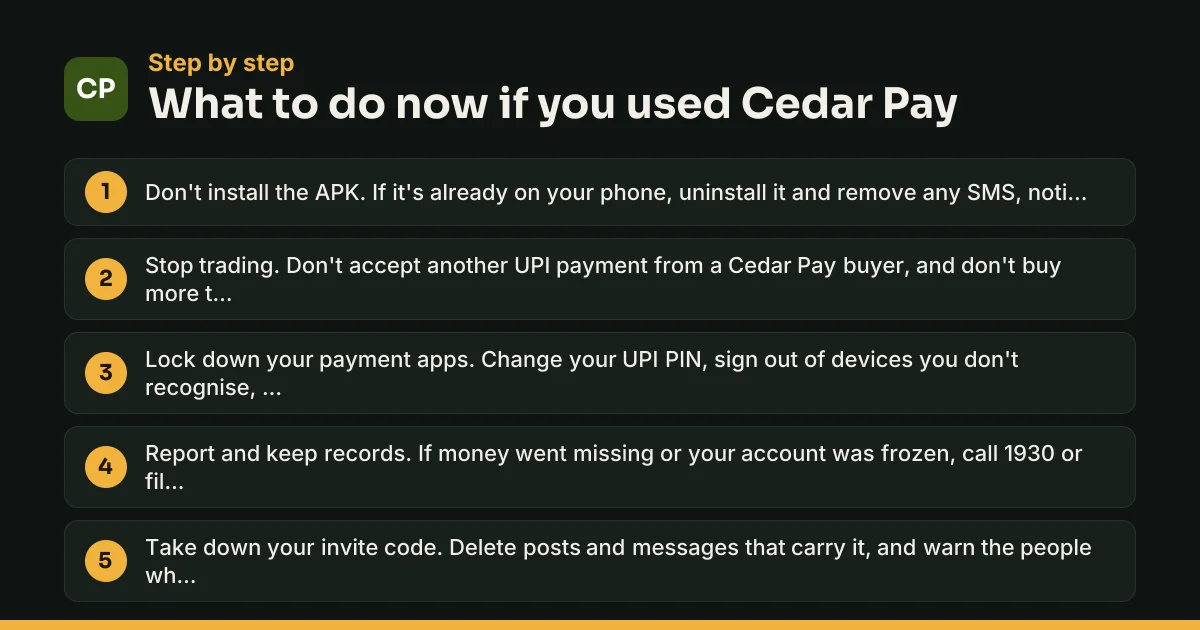
Ring the 1930 helpline or lodge a complaint on cybercrime.gov.in, then inform your bank. Hold on to every UTR, buyer UPI ID and trade screenshot.
Should I uninstall Cedar Pay?
Yes. Stop trading first, then uninstall it, remove any SMS or notification access it had, and change your UPI PIN.
Written by Recharge n Deals Team
We sign up for every app we list, test the code ourselves and recheck it when the offer changes. Read how we test codes. Code not working? Tell us and we'll recheck it.
Disclaimer: Cedar Pay is a trademark of its owner. We are not affiliated with Cedar Pay. Offers are set by Cedar Pay and can change at any time; check the app before you sign up.